
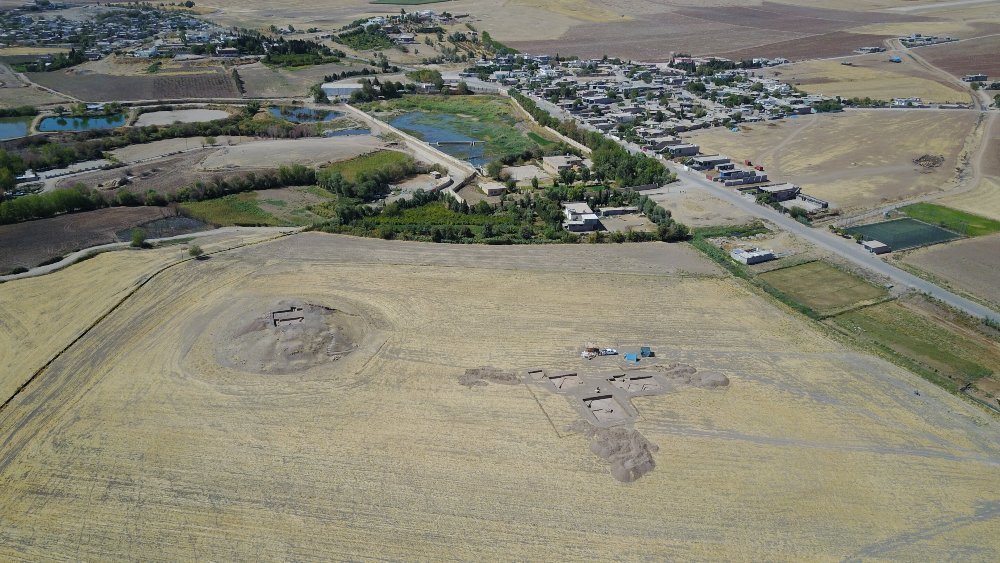


Archaeologists have completed excavations in northern Iraq, making important discoveries. Researchers from Frankfurt University Goethe studied the Gird-i-Kazhau monument in Kurdistan.
This is a settlement dating back to around 500 AD. BC, was first discovered in 2015, but its purpose remained unclear.
It was originally thought that this building might be a church: this was hinted at by five pillars, partially plastered with white plaster. Geophysical surveys have also revealed underground walls, leading to the hypothesis that it may have been a monastery. However, the connection with the neighboring Sasanian fortification of the 5th-6th centuries and the Islamic cemetery still requires additional research.
Фото: DFG project Rural Settlements of the Sasanian Period, Tamm/Wicke
Excavations focused on two zones: around the pillars (zone A) and in the Islamic cemetery (zone B), with an emphasis on anthropological data. In Area A, brick walls and floors made of compacted earth, stones and broken bricks were found.
An unexpected discovery was additional stone columns, indicating the possible existence of a three-nave structure with a central nave approximately 25 meters long. (A nave is an interior space, especially in churches and basilicas, divided by columns.) This is reminiscent of early Christian architecture in the region, but the purpose of these spaces requires further research.
Another unexpected discovery was a room with a floor of carefully laid baked bricks, with a semicircular wall in the north-west. Fragments of decorated pottery depicting a Maltese cross were also found.
This confirms the hypothesis that the building could have served as a Christian meeting place in the 5th-6th centuries AD. e., which is typical for northern Syria and Mesopotamia.
Фото: DFG project Rural Settlements of the Sasanian Period, Tamm/Wicke
If both buildings indeed date from the same period, this would suggest that Zoroastrians, followers of the religion’s founder Zarathustra, and Christians lived side by side at that time.
Archaeologists note that traditionally, research has focused on the capitals of ancient empires, while rural regions have often remained in the shadows. However, it was rural communities that played a key role in supporting economic and cultural life by providing goods to the cities.
Work at Gird-i-Cajau will continue next year using archaeometric methods including archaeobotany, zoology and forensic anthropology. The goal will be to study daily life inside the excavated walls and find out how this rural settlement functioned.
Disclaimer: This news article has been republished exactly as it appeared on its original source, without any modification. We do not take any responsibility for its content, which remains solely the responsibility of the original publisher.
Author:
Published on:2025-12-19 19:45:00
Source: naukatv.ru
Disclaimer: This news article has been republished exactly as it appeared on its original source, without any modification. We do not take any responsibility for its content, which remains solely the responsibility of the original publisher.
Author: uaetodaynews
Published on: 2025-12-19 22:29:00
Source: uaetodaynews.com