Ive Never Had A Pension. Now 64, Im Terrified About What The Future Holds
Ive Never Had A Pension. Now 64, Im Terrified About What The Future Holds


It’s 3am and I am sitting bolt upright in bed, thoughts racing. Waves of fear wash over me and I can hear my heart thumping in my chest.
The reason? My financial future looks grim and I’ve got no idea how I’m ever going to support myself in my later years.
Like most of the country after Rachel Reeves’ Budget raid on pensions, I’m feeling the pressure.
and و in و my – تفاصيل مهمة
But if you’re stressed about having to cut down on holidays and meals out to safeguard your retirement, spare a thought for the 45 per cent of working-age adults, like me, not paying into a pension. In fact, I’veneverpaid into a pension.
Single, 64, and a freelance writer, my crystal ball is foretelling a miserable sort of penury, thanks to my total failure to make any provision for my old age.
In fact, it was only when well-off friends began to complain about their retirement prospects that I even realised the mess I was in. To be frank, I’ve been totally clueless.
Having been freelance most of my life, I’m unsure if I’ll even qualify for the full state pension. You need 35 years of paying National Insurance to get the full amount – currently £230.25 per week.
my و to و of – تفاصيل مهمة
But, like many women with precarious careers, I’m unsure I’ll make the grade. It would have been the same if I’d left work to have kids – I never did have any – but at least then I’d have people to support me.
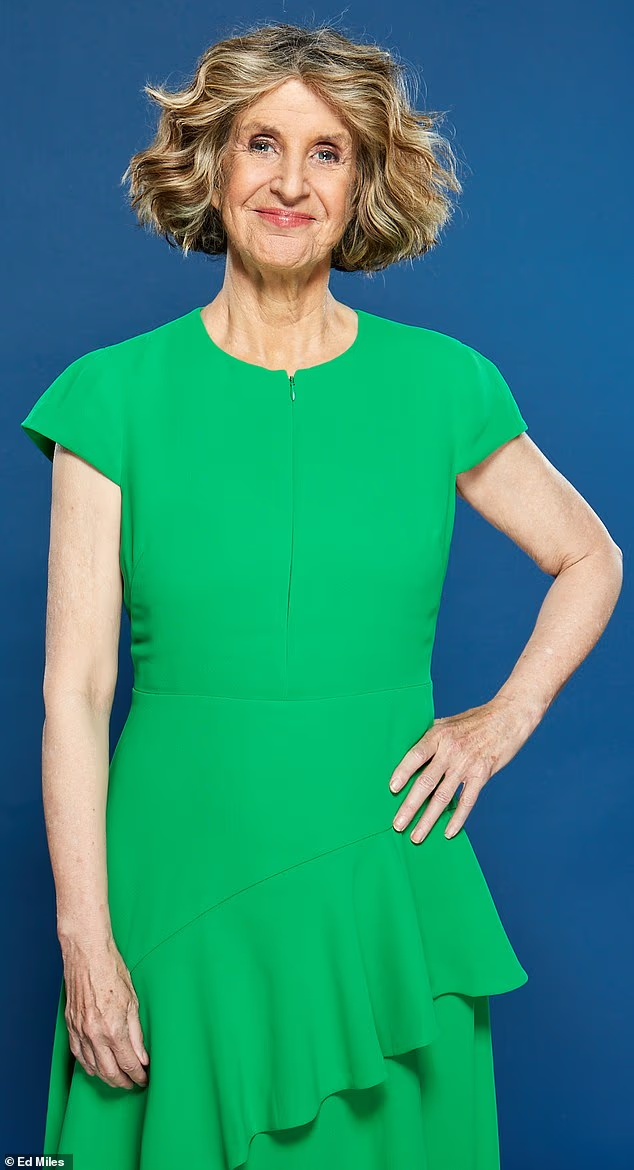
Kate Mulvey has never paid into a pension. As she has worked freelance, she is unsure she will even qualify for the full state pension due to National Insurance rules
she و has و Kate – تفاصيل مهمة
I’m even jealous of the so-called Waspi women campaigning about the changes to women’s state pension age. At least many of them will get the full whack when the time comes.
You’re probably wondering how I can have reached the age of 64 without having ever paid into a pension, and how I can still be so naive about my finances that I’ve done little to rectify the situation.
Perversely, it’s been such a source of anxiety I subconsciously ignored the reality not only of getting older, but of the need to have clear goals and plans for the future.
Growing up in the 1970s in an artistic family, there wasn’t much money about, so there was no need to think about planning what to do with it, though both my parents had private pensions by their 40s. My father was constantly telling me to put a bit by, but silly me thought she knew better.
the و to و of – تفاصيل مهمة
My 20s were a haze of parties and expensive clothes. I was working as a PR account executive, but the company never enrolled me into a pension scheme and I never thought to ask. Now, I wish my teachers had taught me about pensions and Isas rather than Pythagoras’ theorem.
It was only when I started working as a feature writer in my 30s that I heard colleagues discussing pensions.
But I was a freelancer, and the onus was on me to set up a private pension. It was so many miles down the list of priorities that it simply disappeared. In that, it seems, I’m not alone; 20 per cent of women have no private pension provision.
Saving for the future made sense for my friends, who’d started settling down with husbands and children. But, with no family to support, why did I need to think about saving for later on? It would surely bring me enjoyment to have the extra cash now.
was و I و the – تفاصيل مهمة
Kate has even gone teetotal to pinch the pennies, saving money by drinking fizzy water instead of wine
I remember drumming my fingers on the table in boredom at dinner parties as Smug Marrieds weighed up the benefits of various schemes. How tedious, I thought, as I sloped off to some nightclub.
the و I و to – تفاصيل مهمة
I look back on that woman and want to shake her. I secured various book deals over the years, and could have used the sizeable advances to top up my pension pot, or even put a deposit on a house. When the opportunity arose in 1996 to buy a flat, I chose not to, spending the money on clothes instead.
Ever the optimist, I always assumed things would just turn out OK. Or, to be specific, I always believed I’d get married, and he’d give me security. Fat chance.
I used to think my unconventional life was better; forward planning felt oppressive and scary. But I can’t tell you how many times I have come home to a cold house and an empty fridge and felt dejected and frightened.
When I hit my 50s and realised that male-shaped pot at the end of the rainbow wasn’t going to appear, I started to seriously worry about my finances, but was unsure how to mitigate the problem. Today, I feel a kind of hopelessness that I’ve left everything too late.
I و to و and – تفاصيل مهمة
My earnings tide me over, but I rarely have enough left to stash anything for a rainy day, let alone for retirement.
I’m lucky to have had a flat left to me by my parents – which I live in, paying the small mortgage and service charge – otherwise I’d definitely be living in a flatshare.
Without a partner to shoulder the burden, I’m covering everything with my earnings, which are unpredictable.
Though I’m – finally – trying to improve my financial situation, it’s a far cry from friends who, while worrying about their finances, don’t realise how lucky they are. They talk about stocks, shares and Isas and I feel a shiver of inadequacy.
a و to و – – تفاصيل مهمة
I know it’s my fault. As I look at their comfortable lives it just emphasises that I’ve thrown everything away for a life of momentary pleasures. The stress has seen me develop chronic migraines and anxiety.
There’s a stigma about being old and poor. You’re meant to have set yourself up for a comfortable old age, and people get uncomfortable when you moan about not being able to pay the bills. It all has a whiff of Eau de Failure about it.
It takes its toll on friendships, too. It’s painful when the people you considered good friends shun you because your lifestyle has slipped behind.
I met up with one friend recently for coffee. She wanted to talk about her husband’s new job and selling their enormous home in Kensington, while I wanted to moan about how eggs and pesto were bankrupting me. I suppose there’s a slight comfort in knowing that a fifth of women are also currently in a similar pension-less situation. But that comfort won’t pay my bills.
a و about و and – تفاصيل مهمة
So, what does the future hold?
I’m now saving money in whatever way I can. I’ve started auditing my finances and looking at pension plans. I’ve gone teetotal and am saving thousands by drinking fizzy water instead of wine. And I love writing as much as ever, so working into my dotage isn’t too bleak a prospect, I suppose.
While I massively regret not giving myself a pension, I don’t regret the fun I’ve had. I just never realised I would be paying such a high price for it.
Tap water, anyone?
I و I’ve و a – تفاصيل مهمة
What to do if you’re in your 60s with no private pension
Tanya Jefferies, Pensions and Investments Editor, says:
- It’s not too late – open a self-invested personal pension (Sipp) and contribute what you can afford each month. These can be opened in addition to a work pension, and are also suitable for the self-employed. If you’re employed you should be automatically enrolled into a pension, and if you opted out you can easily still re-join. The money should grow in a tax-efficient way and provide a useful lump sum or an income to draw on when you’re older.
- Check your state pension and if you haven’t paid the required amount of National Insurance to earn enough qualifying years you can buy annual top-ups to fill up any gaps over the past six years. It’s worth scraping the money together. It costs roughly £900 per one-year top-up – less for a part year. Once you start getting your state pension you’ll earn what you paid back quickly – usually within three-and-a-half years – so as long as you live to 70, you’ll make your money back. After that, it’s all profit! Check your NI contributions here: gov.uk/check-state-pension
- If you can’t afford to do either of the above then there is a state safety net. If you’re struggling to get by on less than £227.10 a week – i.e. not the typical full state pension amount – after reaching state pension age, you can apply for pension credit to top up your weekly income to at least that amount. Contact Age UK on 0800 678 1602 or Independent Age on 0800 319 6789 to discuss what you might be eligible to claim now or in the future.
Disclaimer: This news article has been republished exactly as it appeared on its original source, without any modification.
We do not take any responsibility for its content, which remains solely the responsibility of the original publisher.
Disclaimer: This news article has been republished exactly as it appeared on its original source, without any modification. We do not take any responsibility for its content, which remains solely the responsibility of the original publisher.
Author: uaetodaynews
Published on: 2025-11-28 01:40:00
Source: uaetodaynews.com

Find the latest breaking news and in-depth coverage on world affairs, business, culture, and more